



Click on image to open expanded view
Item No.
52931
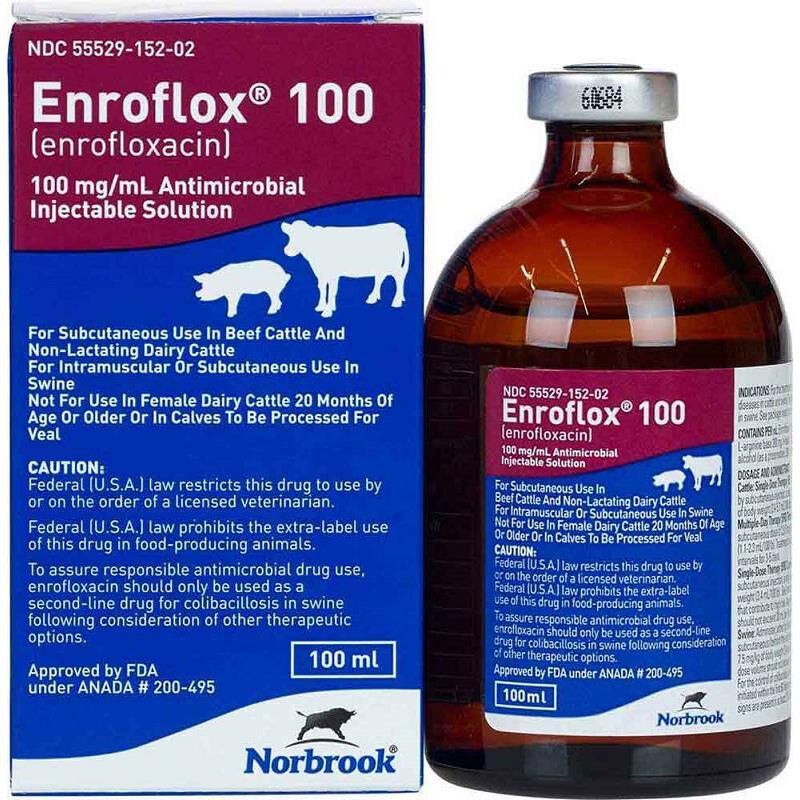
Enroflox 100 (Enrofloxacin) Injectable for Cattle and Swine Rx
AutoShip & Save 40%

Subscription makes it easier to keep your pet's medications on hand!

Convenience: We contact your vet when it’s time to renew your pet’s prescription.

Reminders: You’ll receive reminders prior to shipping, so you’ll have time to make changes.

Savings: Save on the initial order PLUS 5% on future deliveries.

Flexibility: Easily change, skip, or cancel anytime on your My Subscription page.

Support: Our customer service team is here to help with any questions or concerns.
Size:
You may also like
Product Description
Enroflox 100 is a sterile, ready-to-use injectable antimicrobial solution that contains enrofloxacin, a broad-spectrum fluoroquinolone antimicrobial agent. INDICATIONS:
Cattle - Single-Dose Therapy: Enroflox 100 is indicated for the treatment of bovine respiratory disease (BRD) associated with Mannheimia haemolytica, Pasteurella multocida, Histophilus somni and Mycoplasma bovis in beef and non-lactating dairy cattle; and for the control of BRD in beef and non-lactating dairy cattle at high risk of developing BRD associated with M. haemolytica, P. multocida, H. somni and M. bovis.
Cattle - Multiple-Day Therapy: Enroflox 100 is indicated for the treatment of bovine respiratory disease (BRD) associated with Mannheimia haemolytica, Pasteurella multocida and Histophilus somni in beef and non-lactating dairy cattle.
Swine: Enroflox 100 is indicated for the treatment and control of swine respiratory disease (SRD) associated with Actinobacillus pleuropneumoniae, Pasteurella multocida, Haemophilus parasuis, Streptococcus suis, Bordetella bronchiseptica and Mycoplasma hyopneumoniae. Enroflox 100 is indicated for the control of colibacillosis in groups or pens of weaned pigs where colibacillosis associated with Escherichia coli has been diagnosed.
Who is Enroflox 100 (Enrofloxacin) Injectable for Cattle and Swine for?
Cattle and Swine
Manufacturer:
Norbrook
Active Ingredients(s):
Enrofloxacin
How is Enroflox 100 (Enrofloxacin) Injectable for Cattle and Swine sold?
Sold in vials of 100 ml, 250 ml and 500 ml.
What special precautions are there?
PRECAUTIONS:
The effects of enrofloxacin on cattle or swine reproductive performance, pregnancy and lactation have not been adequately determined.
The long-term effects on articular joint cartilage have not been determined in pigs above market weight.
Subcutaneous injection in cattle or swine, or intramuscular injection in swine, can cause a transient local tissue reaction that may result in trim loss of edible tissue at slaughter.
Enroflox 100 contains different excipients than other enrofloxacin products. The safety and efficacy of this formulation in species other than cattle and swine have not been determined.
Quinolone-class drugs should be used with caution in animals with known or suspected Central Nervous System (CNS) disorders. In such animals, quinolones have, in rare instances, been associated with CNS stimulation which may lead to convulsive seizures. Quinolone-class drugs have been shown to produce erosions of cartilage of weight-bearing joints and other signs of arthropathy in immature animals of various species. See Animal Safety section for additional information. HUMAN WARNINGS:
Not for use in humans. Keep out of reach of children. Avoid contact with eyes. In case of contact, immediately flush eyes with copious amounts of water for 15 minutes. In case of dermal contact, wash skin with soap and water. Consult a physician if irritation persists following ocular or dermal exposures. Individuals with a history of hypersensitivity to quinolones should avoid this product. In humans, there is a risk of user photosensitization within a few hours after excessive exposure to quinolones. If excessive accidental exposure occurs, avoid direct sunlight.
What to do if overdose?
Contact your nearest emergency animal hospital.
How can I store Enroflox 100 (Enrofloxacin) Injectable for Cattle and Swine?
Protect from direct sunlight. Do not refrigerate or freeze. Store below 77°F (25°C). Precipitation may occur due to cold temperature. To redissolve, warm and then shake the vial.
Overview
Use as directed by your Veterinarian. DOSAGE AND ADMINISTRATION:
Enroflox 100 provides flexible dosages and durations of therapy.
Enroflox 100 may be administered as a single dose for one day for treatment and control of BRD (cattle), for treatment and control of SRD or for control of colibacillosis (swine), or for multiple days for BRD treatment (cattle). Selection of the appropriate dose and duration of therapy for BRD treatment in cattle should be based on an assessment of the severity of the disease, pathogen susceptibility and clinical response.
Cattle:
Single-Dose Therapy (BRD Treatment): Administer, by subcutaneous injection, a single dose of 7.5-12.5 mg/kg of body weight (3.4-5.7 mL/100 lb).
Multiple-Day Therapy (BRD Treatment): Administer daily, a subcutaneous dose of 2.5-5 mg/kg of body weight (1.1-2.3 mL/100 lb). Treatment should be repeated at 24-hour intervals for three days. Additional treatments may be given on Days 4 and 5 to animals that have shown clinical improvement but not total recovery.
Single-Dose Therapy (BRD Control): Administer, by subcutaneous injection, a single dose of 7.5 mg/kg of body weight (3.4 mL/100 lb). Examples of conditions that may contribute to calves being at high risk for developing BRD include, but are not limited to, the following:
• Transportation with animals from two or more farm origins.
• An extended transport time with few to no rest stops.
• An environmental temperature change of =30°F during transportation.
• A =30°F range in temperature fluctuation within a 24-hour period.
• Exposure to wet or cold weather conditions.
• Excessive shrink (more than would be expected with a normal load of cattle).
• Stressful arrival processing procedures (e.g., castration or dehorning).
• Exposure within the prior 72 hours to animals showing clinical signs of BRD.
Administered dose volume should not exceed 20 mL per injection site.
Main Ingredients
Enrofloxacin 100 mg/mL Antimicrobial Injectable Solution